Sight-reading drills, daily · now on iOS
A sight-reading trainer for piano.Not a game.
Daily drills for note reading, intervals, chords, key signatures, scales and arpeggios, scheduled by spaced repetition so you remember what you forget. Built for adult beginners and returning players who can find middle C but still decode notes slowly.
Free to read notes. Everything else from $3.33/month, or a one-time Lifetime.

No MIDI keyboard needed. Tap or type works. Have one? Connect it for faster, more precise answers.
Try a session, right here
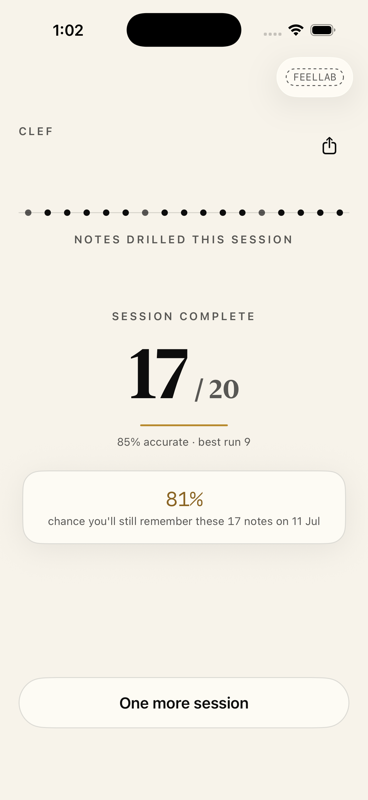
SESSION COMPLETE
You just did a Clef session.
That's one session. Clef gives you a new one every day.
THE PROBLEM
Whether you're just starting out or picking piano back up, most practice time disappears into playing through songs. Song apps make it worse: your fingers memorize one piece while the skills underneath, naming notes without counting lines, seeing intervals at a glance, knowing your key signatures, never get trained. Those are recall skills, like vocabulary. They get faster when you isolate them, drill them in short timed bursts, and get told instantly when you're wrong. That's what a Clef session is: three minutes of real piano training, not another run-through.
HOW IT WORKS
Three minutes of piano training, three steps.
-
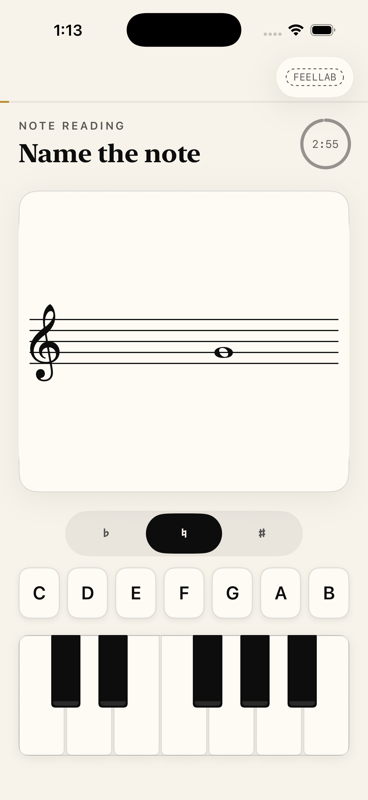
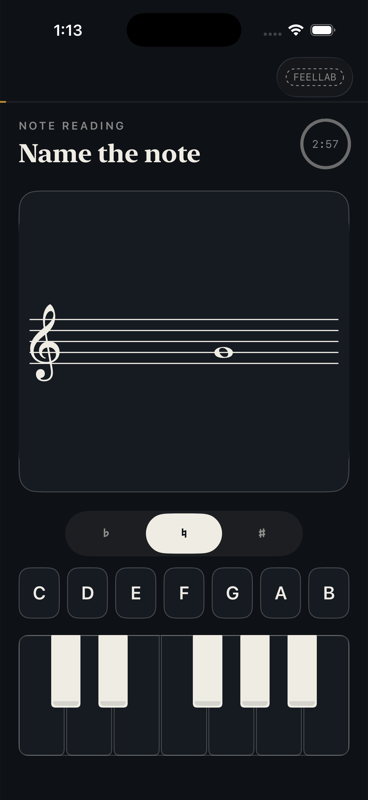
See a drill.
A note to name, an interval to judge, a key signature to spot, right on the staff, where it sits in real music. No warm-up, no menu.
-
Answer it, fast.
Tap the answer, type it, or play it on a MIDI keyboard if you have one, all score the same way. The clock is running, so you answer on instinct, not by counting up from middle C.
-
Let the scheduler remember.
Clef tracks exactly which items trip you up, notes, intervals, keys, and brings them back before you forget them. Spaced repetition, not blind repetition.
ON iOS
See it, then download it
GET CLEF
Clef is live on the App Store.
Treble and bass single-note reading drills stay free, with streaks. The full training system starts at $39.99/year, about $3.33/month, billed annually. Monthly is $6.99/month. Lifetime is available for $99.99.
The free tier also includes one mixed daily session across all 15 tracks, every day.
QUESTIONS
Questions before you join
Who is Clef for?
For adult beginners and returning players who can find middle C but still decode notes slowly. Sight reading is the flagship track. The same app also trains both clefs, ledger lines, intervals, key signatures, five-finger patterns, triads, scales and arpeggios, so there's plenty of room to grow.
Is Clef only about reading sheet music?
No. Clef is a piano training app, and reading is the flagship track because it unlocks everything else. The drill library already covers both clefs, ledger notes, intervals and key signatures, plus five-finger patterns, triads, scales and arpeggios, all scheduled by the same spaced-repetition engine. Every new drill pack is a free update.
Won't this be too basic for me?
Eleven tracks say otherwise: treble and bass note reading, grand staff, ledger lines, intervals, key signatures, five-finger patterns, triads, scales and arpeggios, all scheduled by the same engine that tracks exactly what you get wrong. Sight reading is the flagship track. The rest goes as deep as you want to take it.
Why not just use Duolingo or a gamified app?
Gamified apps optimize for engagement: streaks, mascots, points you chase instead of skill you build. No cartoon owl. No guilt trips. Just the drill, one screen, one goal, name the note as fast as you can, so every session is real practice.
Do I need a MIDI keyboard?
No. Tap the on-screen keys or use your computer keyboard; both work exactly the same for scoring. If you do have a MIDI keyboard, connect it for faster, more precise answers, since playing the actual key beats tapping a screen.
What is free in Clef?
Treble and bass single-note reading drills stay free, with streaks. The full training system, intervals, key signatures, chords, scales, spaced repetition, custom lessons and analytics, is available with Annual at $39.99/year, about $3.33/month, billed annually; Monthly at $6.99/month; or Lifetime for $99.99.
Why does Clef offer subscriptions?
Clef keeps improving every week: new drills, scheduler work, custom lessons and analytics need ongoing care. Subscriptions support that work. Note-reading stays free, and Lifetime is available for people who prefer a one-time purchase.
When does Clef launch on the App Store?
Clef is live on the App Store now. Treble and bass single-note reading drills stay free. The full training system is available as Annual, Monthly, or Lifetime.
How do I learn to read sheet music?
Reading sheet music is a recall skill, so it responds to short, frequent practice more than long study sessions. Start with the treble clef, learn where each line and space sits, then drill naming notes until it stops feeling like decoding. A few minutes a day beats one long weekly session.
What is the best way to practice note reading?
Rapid repetition with immediate feedback. Instead of reading through songs, isolate the single skill of note identification, answer as fast as you can, and let a scheduler resurface the notes you get wrong more often. That is what this trainer does in a 3-minute session.
How do I remember the treble clef notes?
The lines from bottom to top are E, G, B, D, F and the spaces spell F, A, C, E. Mnemonics get you started, but fluency comes from drilling until you no longer count up from a reference note. This name-the-note game is built for exactly that.